
Spray foam insulation in Los Angeles
A two-part liquid that expands to fill gaps, then sets. It insulates and seals air leaks in one pass, where the job suits it.
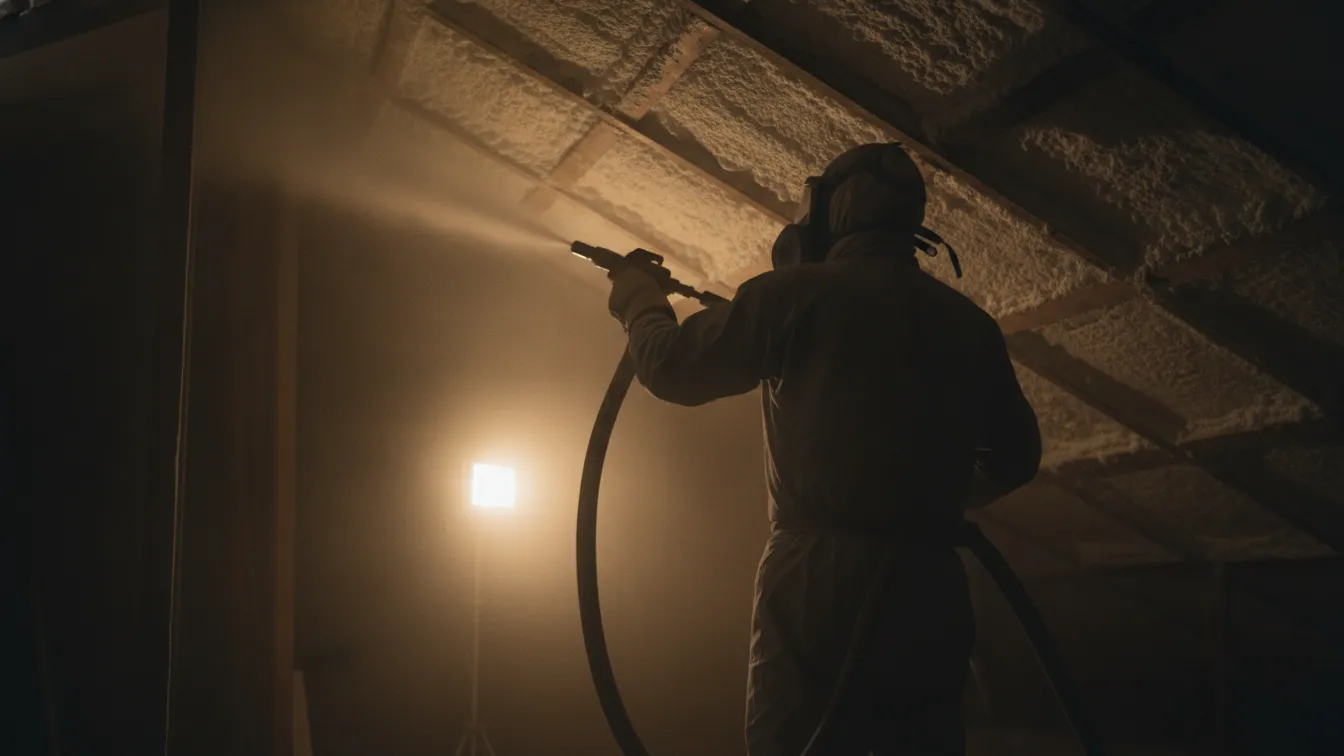
Spray foam insulation is applied as a liquid and expands into a foam that fills gaps, cracks and odd corners.
That makes it both an insulator and an air barrier. We apply spray foam insulation in homes across Los Angeles, from Culver City, West Hollywood and Hollywood to Calabasas, Thousand Oaks and Palos Verdes Peninsula.
Foam is not the right answer for every house. In some attics blown-in insulation is the simpler fix, and in others the foam makes the most sense. If you are comparing options, start with all our insulation services and we will help you narrow it down. We are licensed and insured, and we work every day, every day, 7 a.m. to 11 p.m.
Where spray foam is used
Foam earns its place where a loose fill or a batt cannot seal the space.
Underside of the roof deck
Foam applied to the roof deck turns the attic into part of the conditioned space, which is a different approach from insulating the attic floor.
Attic perimeter and odd corners
Low eaves, tight corners and awkward framing that other materials leave gaps in.
Crawlspaces
Walls and underfloor areas, where foam has to hold up to moisture. Read about crawlspace insulation.
Wall cavities
Open walls during a remodel, where foam fills around wiring and plumbing. Read about wall insulation.
Gaps and air leaks
Rim joists, penetrations and other gaps where air moves through the house.
Vaulted ceilings and flat roofs
Roof assemblies with no attic floor to blow insulation onto.
Open-cell and closed-cell spray foam
Spray foam insulation comes in two forms. They are chemically similar and differ in how the foam is built.
- Open-cell foam is soft and light. It blocks air well, lets water vapor pass through, and can soak up and hold liquid water if it gets wet.
- Closed-cell foam is dense and rigid. It does not absorb water, acts as a vapor retarder, and is stronger. There is more material in every foot of it, so it costs more.
Neither is better in every place. The choice follows the part of the house, how much moisture it sees and how much room there is.
How spray foam is installed
Spray foam insulation is installed by a trained applicator using special equipment. The two parts of the liquid are mixed at the nozzle and sprayed onto the surface, where the foam rises and sets. Closed-cell foam is built up in layers, open-cell foam can be applied thicker in one pass.
Because foam is combustible, building rules require it to be covered. A thermal barrier is the usual cover, and in attics and crawlspaces that are only entered for service, an ignition barrier can be enough, depending on the product. Foam must also be protected from direct sunlight. Limited access in an attic can make the work harder.
Spray foam insulation cost
The cost of spray foam insulation moves with the type of foam, the area to cover, how thick it has to be, how hard the space is to reach and what has to be removed or prepared first. Closed-cell foam costs more than open-cell for the same area, and a roof deck is a bigger job than a patch of gaps. It generally costs more than blown-in insulation, which is why we look at the attic before recommending foam. Our guide to attic insulation cost explains the factors that move the price.
Safety and what to expect in the house
Spray foam chemicals can irritate the lungs, eyes and skin, and in some people cause asthma, so installation is a job for trained people in protective gear. The U.S. Environmental Protection Agency advises that occupants and other trades stay out of the work area until the foam has cured, the space is ventilated and the manufacturer's re-occupancy instructions are met. EPA does not give one safe time for every product, so we follow the manufacturer's directions for the foam being used.
Plan for the household, children and pets to stay out of the work area until it is cleared.
Spray foam and our other services
Spray foam works alongside the other jobs we do. If the old insulation in the attic is wet, moldy or soiled by animals, insulation removal comes before new material goes in. For a standard attic floor that needs more depth, attic insulation with blown-in material is often the simpler route. Foam is also an option for wall insulation during a remodel and for crawlspace insulation.
What the visit looks like
You call or send the form
Tell us what is bothering you, which part of the house it is and whether anyone in the household has breathing sensitivities.
We look at the space
We check the surfaces, the moisture history, the access and what is already there, and decide whether foam suits the job.
We explain the choices
You hear whether open-cell, closed-cell or a different material fits the space, and why.
We prepare, apply and clean up
We protect and ventilate the work area, apply the foam in layers where needed and leave the area tidy for the cure.
Spray foam questions
Is spray foam insulation safe?
Once it has cured and the space has been ventilated, the foam sits behind surfaces and does not belong in the room. During installation the chemicals can irritate the lungs, eyes and skin, so only trained people in protective gear should be in the area. Everyone else stays out until the manufacturer's re-occupancy instructions are met.
What are the disadvantages of spray foam?
It generally costs more than blown-in insulation and needs a trained applicator. Foam is combustible and must be covered by a thermal or ignition barrier, and it must be protected from sunlight. Open-cell foam can hold water, and closed-cell foam can make a roof leak harder to find.
Will spray foam insulation keep water out?
Closed-cell foam does not absorb water, while open-cell foam can soak up and hold it. Neither replaces a sound roof. Closed-cell foam on a roof deck can hide a leak, because water does not soak through it the way it does through other insulation.
Can you spray foam insulate your roof?
Yes. Foam can be applied to the underside of the roof deck, which makes the attic part of the conditioned space. It is a different approach from insulating the attic floor, and it is covered by building rules for a barrier over the foam. We look at the roof and attic before recommending it.
What is the difference between open-cell and closed-cell spray foam?
Open-cell foam is soft, lets vapor through and can absorb water. Closed-cell foam is dense, does not absorb water and acts as a vapor retarder. Closed-cell costs more because more material goes into each foot.
Wondering whether foam, blown-in insulation or something else fits your house? Tell us what you are dealing with.
Spray foam insulation
Find out whether foam fits
Call us, or send the form and we will call you back. We work across Los Angeles and Ventura County, every day, 7 a.m. to 11 p.m.